

Projects (e.g., construction, industrial delivery and/or installation projects) generate a huge amount of information every day: work progresses, materials are delivered and received, contractors and installation teams arrive. And at the same time project must address unplanned deviations related to occupational safety, structures, technology, absences and delays — that require constant decision making at different organizational levels.
Yet one of the biggest challenges in project operations is not the amount of information — but its fragmentation.
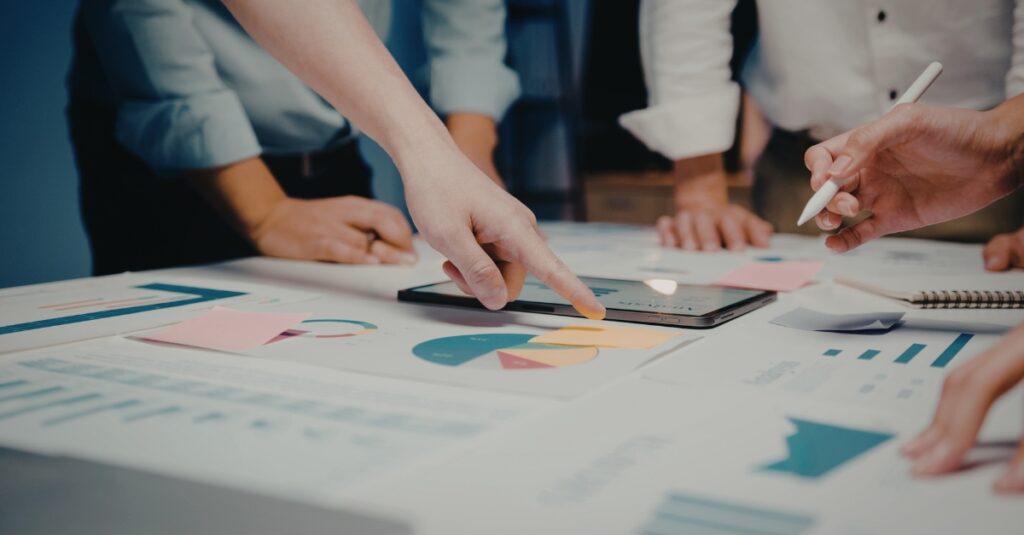
When project management, documentation, audits, safety observations, quality deviations and corrective actions live in different systems, emails and Excel sheets, or even manual memos, organizational transparency quickly diminishes. And management sees the situation with a delay. Deviations remain local problems. At worst, the same mistakes repeat from project to project and risks grow before they are recognized.
And all that eventually show up as:
- reduced profitability,
- increasing quality costs,
- safety deviations,
- warranty repairs,
- difficulty in managing projects,
- and above all poor customer satisfaction and operational control.
Project profitability usually does not collapse because of one big mistake. It weakens gradually, when deviations, delays, quality problems and inefficient use of resources are not recognized in time.
Pressure on companies that carry out projects is increasing. Customers demand better transparency, project risks increase, there is competition for skilled people and constant pressure on profitability. At the same time, management is expected to be able to make decisions faster and based on increasingly accurate information. Therefore, a unified way to manage project business is no longer a development project — but a mandatory prerequisite for competitiveness.
The question is no longer whether information is collected.
The question is whether the organization can convert information into a unified management system.
A unified way to manage projects creates the foundation
Operational management of a company that carries out projects begins with a common operating model.
Without unified processes, each project easily starts to build its own practices:
- documentation varies,
- reporting becomes project-specific,
- information is transferred in different ways,
- management depends on individual people.
In such case the organization’s ability to manage the operations weakens.
What does unified management mean in practice?
A unified management system does not mean a single system nor replacing all existing tools. Its purpose is to ensure that information, essential to managing projects and decision making, forms one common way of operating and status snapshot for the entire organisation.
When projects operate based on agreed structure and information is comparable from project to project, management can identify deviations earlier, allocate resources more efficiently and make decisions based on up-to-date information.
Only then does project activity become a manageable instead of isolated projects.
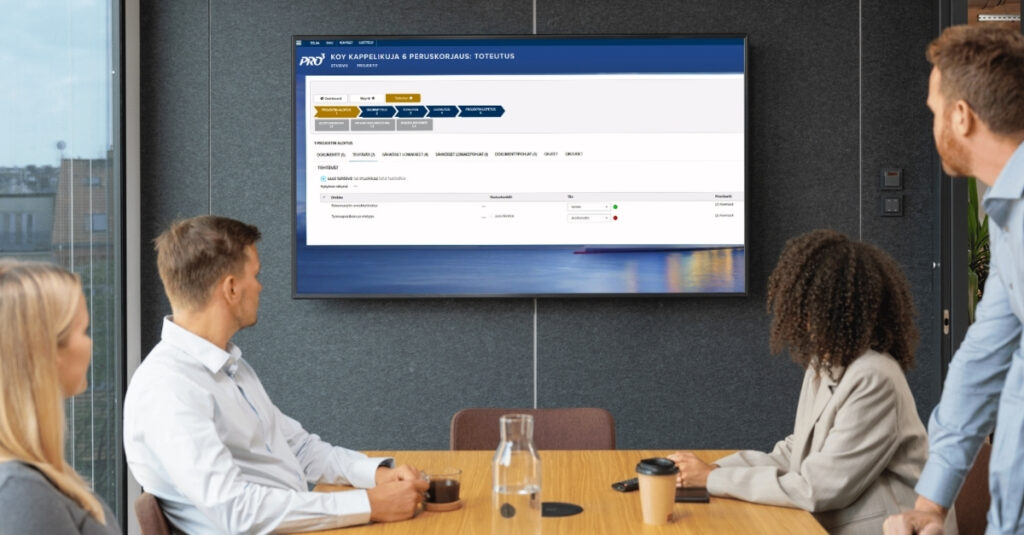
Derigo’s Pro3 project management builds this common foundation. It gathers project management, documentation, processes, reporting and the up-to-date project status into one operational environment.
The core value of Pro3 is not only project control, but the standardisation of ways of working across the organization.
When all projects operate according to common structure:
- information becomes transparent,
- management is unified,
- projects are comparable,
- problems are identified earlier,
- and management gets a real-time view of the entire project portfolio.
Pro3 does not operate as an isolated system, nor does it replace all other systems.
Information is already generated in many different solutions — in sales/project development, design, bid and cost estimating, finance, time tracking, procurement and on-site construction systems. Derigo’s approach focuses on combining these information flows into a single operational situational picture from the perspective of project management.
When information related to project management, delivery/production, finance and quality assurance is combined, management gains a real-time situational picture of projects and the project portfolio.
This creates a foundation for decision-making, data-driven management, continuous improvement and for the organization no longer being dependent on the tacit knowledge of individual people.
Proactive management is based on unified data
When project information is structured, up-to-date and in a unified form, the organization can move from reactive reporting to proactive management.
The project data produced by Pro3 also enables effective use of AI in the future for example in:
- identifying deviations,
- predicting schedule and resource risks,
- prioritizing corrective actions,
- and analysing the project portfolio.
However, AI does not solve the problem alone. Its benefit always relies on high-quality, unified and transparent data. Therefore, functioning project management and unified operating models are also prerequisites for genuinely useful AI utilisation in project business.
Goal: a unified management system
When you want to develop your company, project management alone is not yet enough. Even if projects are well managed, the company’s real performance is determined by how the organization reacts to deviations, learns from observations and can systematically improve its operations.
Derigo’s solution is built step by step:
By a management system we mean a whole in which project management, operating models, information management, deviation handling and the situational picture that is central for decision-making form one unified operating model. Pro3 project management, as the first step, creates the foundation for project leadership and already brings significant benefits through a unified operating model — smoother everyday operations, more flexible resourcing, better quality and customer satisfaction.
You can adopt Pro3 extensions according to the areas you want to develop. These can include for example:
- Audits and continuous improvement management
- Deviation observations and observation centre
- Risk and opportunity management
- Supplier information management and supplier evaluations
- Management of procurement packages and requests for quotation
- Sustainability (ESG) management
Pro3 integrates flexibly with your company’s existing systems producing and collecting information to complement a “360-view” of projects and the project portfolio to support management and decision-making. Pro3 may also act as one source of information for your company’s data warehouse.
The Derigo Pro3 solution family enables step-by-step development of your projects and business operations according to your company’s needs and priorities.
Pro3 project management together with extensions form a transparent management system in which:
- projects,
- deviations,
- audits,
- corrective actions,
- risks and
- operational performance
are part of the same system.
For company management this means a better ability to lead operations based on information — not only after problems arise, but proactively at the level of the whole project portfolio.
At best it is not only about better project management, but about the company being able to turn fragmented operational information into a unified management capability — which improves predictability, reduces risks and builds competitive advantage across the project portfolio.
How to proceed toward a unified management system
Above we described how one can move from managing an individual project toward a unified management system. However, it is not a single undertaking, nor a change implemented all at once, but a longer development journey that advances in phases toward a more unified operating model.
The operating environment is constantly changing, technologies develop further, business requirements change and new needs arise along the way. Therefore, the management system must also be flexible and evolving, not rigid or a one-off solution.
Pro3’s modular structure supports this development. It enables building a unified operating model step by step while the company develops its operations and capabilities. You can utilize the market’s best solutions in different areas, such as BIM, site systems, etc.
When project management, information central to decision-making and up-to-date operational dashboard are collected step by step into a structured system, the organization can proceed in a controlled manner toward a situation where a genuinely unified management system is in use — without the need for one-off and heavy system renewals.

How well is your project portfolio manageable today?
In many companies the information exists but combining it to support decision-making is still a challenge. A unified management system can be built step by step without heavy system renewals.
If you want to evaluate your situation and development opportunities, get in touch.
Petri Tarjamo
+358 50 322 7019
petri.tarjamo@derigo.fi
Ei kommentteja vielä